At a glance
A side-by-side look at the picks in this guide. Always check the live Amazon listing for current specifications and price.
Swipe sideways to see the full table.
| Pick | Best for | What stands out | Worth knowing | Check price |
|---|---|---|---|---|
| Cat Wall Furniture, 13 IN 1 Moon & Bridge Cat Wall Shelves, Green | Small rooms and confident climbers | Slim shelves save floor space in small homes | Requires wall anchoring | Check Price on Amazon |
| Globlazer Z78 Heavy Duty Cat Tree for 20lbs Large Adult Cats, Light Grey | Maine Coons, Ragdolls and 15 lb+ cats | Wide 28-inch base and low centre of gravity | Takes up more floor space than a slim tower | Check Price on Amazon |
| PAWZ Road Floor to Ceiling Cat Tree, Adjustable 95"-108" Leopard Cat Tower | Small rooms and vertical climbers | Uses vertical space instead of floor space | Needs a solid ceiling and careful tension adjustment | Check Price on Amazon |
| 8 Packs in 1 Cat Scratch Pad, Cat Scratcher Cardboard,Reversible,Durable Recyclable Cardboard, Premium Scratch, Suitable for Cats | Cats who scratch rugs and sofa corners | Inexpensive way to test a horizontal scratcher | Loose cardboard bits need occasional vacuuming | Check Price on Amazon |
| Training Tape, Cat Tape for Furniture, Scratch Deterrent Keep Cats from Scratching Furniture with Our Double -Sided Repellent, 2.5 | Sofa arms and chair corners | Clear finish is less obvious than bulky plastic guards | Some cats simply move to another corner | Check Price on Amazon |
Apartment-friendly cat furniture is about using height and corners instead of filling the floor. In a small flat, your cat still needs a scratching surface, an elevated lookout and a comfortable place to sleep; the trick is to combine those jobs into a few stable pieces rather than buying a miniature version of every cat product. A slim tower in a corner, a tension-mounted scratching pole, wall shelves where the wall and lease allow, and a horizontal scratcher that slides under a chair can cover most of it. Measure the floor space first, check how each piece is anchored, and favour stability over clever design. The five picks in this guide are a practical shortlist for a small home.
As an Amazon Associate I earn from qualifying purchases. You can read our affiliate disclosure for the details.
Why apartment cat furniture is a different design problem
Cats do not measure territory in square feet. They care about routes, vantage points, scratching surfaces and places to hide. A small flat can feel rich if those resources are spread out and easy to reach; a large house with one tree in a spare room can feel empty.
Renters have an extra constraint: every hole in the wall is a conversation with a landlord and a cost at move-out. That pushes many people toward freestanding furniture, but freestanding does not automatically mean stable. A tall tower with a narrow base can be more of a risk than a well-anchored shelf. The practical answer is usually a mix: one floor-standing piece for scratching and climbing, one mounted or tension-mounted piece for height, and a movable scratcher that can follow the cat around the room. Our cat trees and scratchers category is the place to compare shapes, but decide on the layout before you browse.
Think in three jobs: scratch, climb and sleep, with a good view from the top. A single cat tree can do all three if it is large enough to do them well. In a tight room, split the jobs across smaller pieces instead of buying a tower with six platforms no adult cat can lie on.
Measure the room before you buy
Start with a tape measure and painter's tape. Mark the footprint of a candidate tree on the floor, then live with it for a day. You will quickly see whether it blocks a cupboard, a radiator, a door swing or the route between the sofa and the kitchen. Leave a clear path of at least 18 to 24 inches through the room; a cat will use a perch more confidently if it does not have to squeeze past it.
Check the ceiling height if you are considering a tension pole, and check the wall construction if you are considering shelves. Note where the sun lands, because a warm window is often more valuable to a cat than another bed, and note where your cat already scratches, sleeps and watches the room. The best placement is usually within a few feet of an existing habit, not in the empty corner that looks tidy in a photograph.
Finally, measure your cat. A large cat needs a perch that is wide enough to lie flat in, not just a platform that supports its weight. Look for the interior width and depth of the perch, and compare that with your cat's nose-to-tail-base length rather than trusting exterior dimensions.
Apartment cat tree ideas that earn their floor space
If you have room for one floor-standing piece, choose a stable tower with a base that is wider than its tallest platform. Height is useful only if the tree does not rock. A corner placement reduces the visual footprint and gives you two walls to brace against, although you should still use the wall anchor if one is supplied.
Much of the small apartment cat furniture on the market is compact but cramped, with perches an adult cat cannot lie on. A space-saving cat tree does not have to be tiny. A narrow tower with deep perches can work, but a large cat may need a wider base and more generous platforms. That trade-off is real: an extra-wide tower takes more floor space, but it is often the difference between a cat using the top perch and avoiding it. If the room can spare a corner, a wide, low-centre-of-gravity tower is a better long-term buy than a slender tree that wobbles.
Place the tree where the cat can see a doorway or a window without sitting in the middle of the traffic. Keep it away from radiators, heaters and windows that open wide, and check that the top perch is not level with a hot lamp or a shelf of breakables. In a multi-cat home, add a second high spot in another room so one cat cannot guard the only good perch. Our guide to choosing a cat tree goes deeper on perch size, stability and materials.
Cat wall furniture ideas that respect the wall
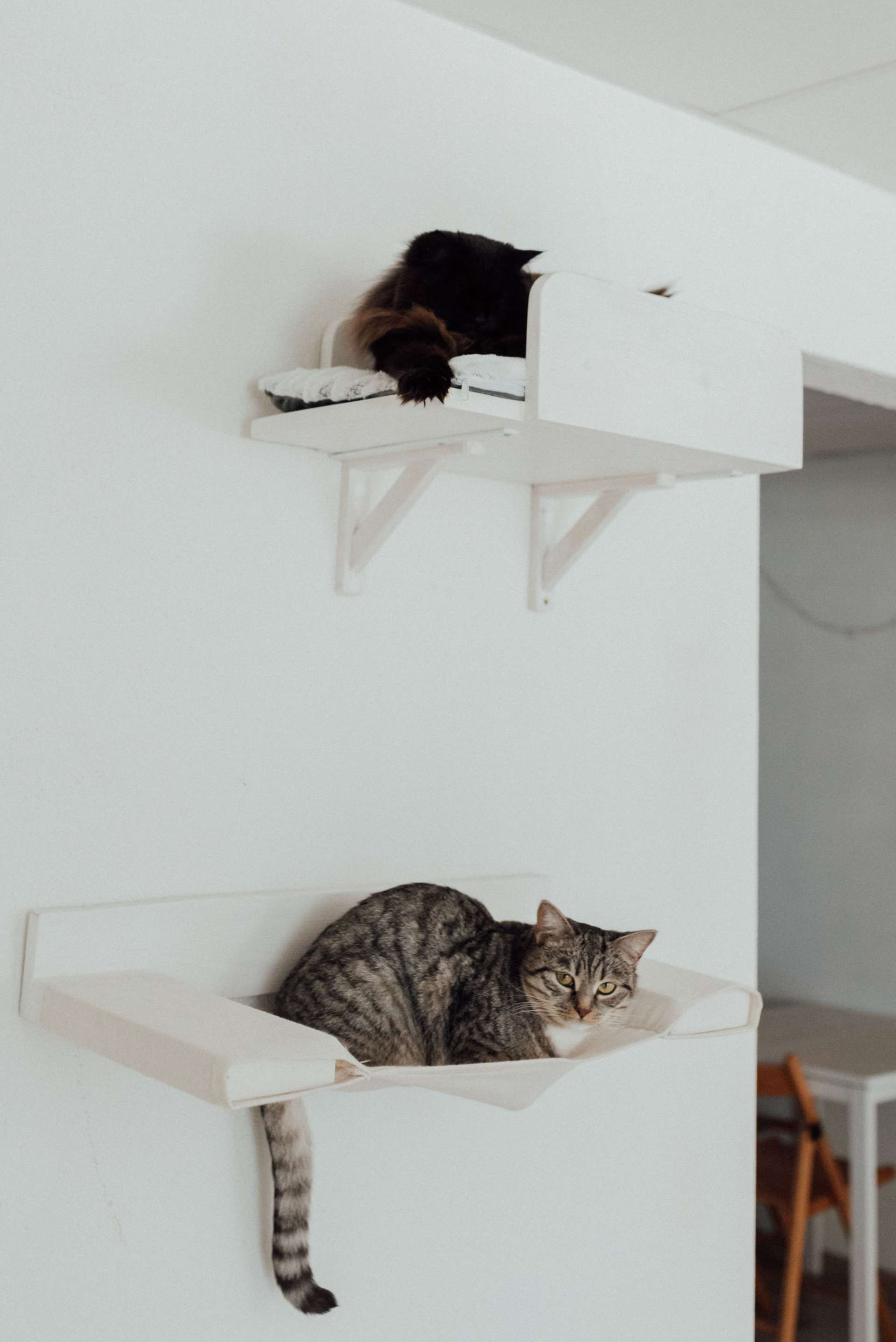
Cat shelves for apartment walls can turn a narrow hallway or a blank wall into a cat highway, but they are not a casual purchase. A shelf needs a safe landing area, a route down and a fixing that suits the wall. As a starting point, look for shelves at least 10 to 12 inches deep for an average cat, with a raised lip or a textured surface so paws do not slide. Large cats need more depth and a higher weight rating.
Plan the route before you drill. Stagger the shelves so the cat can step or make a short, confident jump between them, and avoid dead ends where the cat has to turn around on a narrow ledge. Put the highest shelf near a window if you can, but keep it away from blinds, curtain cords and anything the cat can pull down. Leave a clear landing zone at the bottom; a cat that misses a jump should land on something soft, not a glass table. Our indoor enrichment and window perch guide has more layout ideas.
Mounting decides whether the project is safe. Drywall with wooden studs is the simplest wall to work with; plaster and lath, brick, concrete and panelling need different anchors and sometimes a professional. Adhesive strips are not a mounting system for a jumping cat. No shelf is automatically renter-safe: whether you can install it depends on the wall type and your lease. Ask before you drill, use hardware rated for the load, and check the screws after the first week. If you cannot mount anything, a tension pole or a freestanding tower is the safer route.
Floor-to-ceiling poles: vertical space without drilling
A tension-mounted scratching pole is one of the few ways to add full-height climbing without making holes. The pole wedges between the floor and ceiling, and many models include two perches and a long sisal column. It is a good fit for a small flat because the footprint is tiny, but it only works if the ceiling is solid and the pole is installed correctly.
Check three things before you buy: the manufacturer's height range, the weight rating and the ceiling type. A drop ceiling or a fragile plaster ceiling is not a safe anchor. Measure the height at the exact spot where the pole will stand and follow the assembly instructions for tension. Recheck the tension after a few days and again after a month; a pole that loosens can lean or fall.
A tension pole is not the best choice for every cat. Very heavy or very energetic cats need a model rated for their weight, and some cats simply prefer a solid tree. For a confident climber in a small flat, though, it adds a full-length stretch and a high lookout in less than a square foot of floor space. Check the tension and the perch fixings every week, and replace the pole if the spring or thread starts to fail.
Scratching surfaces that fit a small home
Cats scratch to stretch, mark territory and maintain their claws, so a small home still needs at least one satisfying surface. A horizontal cardboard pad is easy to slide under a chair or beside the sofa, and a reversible pad gives you two fresh sides before you replace it. A tall sisal post is better for a cat that stretches upward; a short pad on the floor will not satisfy that cat no matter how many you buy.
Place the scratcher next to the piece of furniture your cat already targets, not in a spare room. If the sofa arm is the favourite, put a vertical post beside it and a horizontal pad on the floor nearby. Reward calm investigation and do not force the cat's paws onto the surface. If you need a temporary barrier while the habit changes, clear double-sided tape can make a corner less rewarding, but test it on a hidden patch first; some fabrics and leather finishes do not tolerate adhesive. The tape is a training aid, not a permanent solution.
Keep nails trimmed and replace worn surfaces before the cat looks for a better one. A tall post and a floor pad cover two scratching styles, which is more useful than three pads in the same corner.
A sleeping spot that does not block the room
Most cats sleep for a large part of the day, and they like a warm, high or hidden spot. A bed on top of a tower or a shelf gives them that without adding another piece of floor furniture. If your cat is older or has mobility changes, choose a low-entry bed or a perch that is easy to reach; a high shelf that requires a big jump may go unused. Our guide to best products for senior cats covers low-entry options and easier access.
Put the bed where the cat already naps, not where you want the room to look finished. A window seat with a view is often a better investment than a third bed. Keep the cover washable and avoid radiators and draughty doorways. In a very tight room, a folded blanket on a wide, secure window sill can be enough.
Renter-friendly cat furniture: what to check before you drill
Before you buy shelves or a wall-mounted bed, identify the wall. Knock on it: a hollow sound usually means drywall over studs, while a dense, hard sound can mean brick, concrete or plaster. A stud finder is more reliable than guessing. Drywall anchors are rated for specific loads, and a cat landing on a shelf creates a dynamic load that is much higher than the shelf's own weight.
Use the manufacturer's mounting hardware when it is supplied, and replace it if it is unsuitable for your wall. Fix into studs wherever possible. If the wall is plaster and lath, brick or concrete, ask a professional or choose a freestanding alternative. Check your lease before drilling; some landlords allow picture hooks but not shelf brackets.
Also secure tall freestanding furniture. A tower that a cat launches from can tip, and a chest of drawers or a bookshelf is not a cat tree. Use furniture straps or anchors where appropriate, and keep the heaviest items on the bottom. If you are unsure, do not mount it. A wobbling shelf is worse than no shelf.
Layout for a studio or one-bedroom
Divide the room into zones even if there are no walls. Keep the litter box away from food and water, and give the cat a quiet route to it. Put the main scratcher near the sofa and the main perch near a window. If the flat is a studio, a tall shelf or a tension pole can create a visual boundary without blocking light.
Leave the centre of the room open. Cats like to move along edges and behind furniture, so a clear perimeter is more useful than a cluster of toys in the middle of the floor. Rotate a few toys rather than leaving everything out at once. If you are bringing home a kitten, our kitten starter kit checklist covers the first purchases and a safe room setup. With two cats, add a second high spot and scratching area in different locations rather than lining up both beds on the same shelf.
Safety checks for small-space furniture
Give every new piece a shake before the cat uses it. Tighten bolts, check that the base sits flat and look for sharp edges or exposed staples. Fit the wall anchor if one is supplied; a tall tower in a small room is more likely to be knocked during play.
Check the ceiling pole regularly. Keep cords out of walkways and away from chewing cats, secure window screens before placing a perch in front of one, and remove small bells, clips or loose toys a cat could swallow. Trim frayed sisal before it becomes a chewable loop. Do not put a high perch above a stove, radiator or glass table; a cat that slips should land somewhere safe.
Our shortlist
These five pieces cover the jobs we have described: a wall shelf set for vertical routes, a wide tower for large cats, a tension pole for height without drilling, a reversible cardboard pad for horizontal scratching and clear tape for temporary furniture protection. We look for stable bases, sensible dimensions and surfaces that are easy to maintain. We have not tested every piece in every apartment, and we do not invent ratings. Check the current dimensions, weight ratings and mounting requirements on the live Amazon listing before you buy, and measure your wall and ceiling first.

 Limited-Time Deal on Amazon


A small home can still be a rich territory
The best apartment cat furniture gives your cat a safe place to scratch, climb and watch without taking over the room you share. Start with one good scratcher and one elevated perch, place them where your cat already spends time, and add a second route only when you can do it safely. Check the wall, check the ceiling and check the base. A small flat with a few well-chosen pieces can feel much larger to a cat than a big house with nothing to climb.
Related guides
- Indoor cat enrichment and window perches for more ways to use height, views and play.
- Kitten starter kit checklist for setting up a first room and choosing the basics.
- Best products for senior cats for low-entry beds and easier access.
Common questions
What is the best cat furniture for a small apartment?
Start with one stable scratching post and one elevated perch, then add a horizontal scratcher and a sleeping spot. A slim floor-to-ceiling pole or a corner tower uses height instead of floor space. Wall shelves can add a route around the room if the walls and lease allow. The best choice is the piece your cat will actually use, not the one with the most levels.
Are wall-mounted cat shelves renter friendly?
Not automatically. It depends on the wall construction and your lease. Drywall with wooden studs can usually take a well-anchored shelf, while plaster, brick, concrete and panelling need different fixings. Ask your landlord before drilling, use hardware rated for the load, and do not rely on adhesive strips for a jumping cat. If you cannot drill, choose a tension pole or a freestanding tower instead.
How do I stop a cat tree from taking over a small room?
Choose height over width, place it in a corner or beside a window, and avoid pieces that block a walking route. A tower with a footprint of about two feet square can still give a cat a high perch if the base is stable. Measure the floor space with tape before ordering. If the room is very tight, a wall shelf or a tension pole may add more territory than another floor-standing tree.
Do cats need a cat tree in a studio apartment?
They need scratching opportunities, a safe high place and a comfortable bed, but those do not all have to come from a traditional cat tree. A sturdy shelf, a window perch, a scratching pole and a cardboard pad can cover the same needs in less floor space. A tree is convenient because it combines several jobs, but it is not the only option.
How do I protect furniture in a rental?
Put a scratcher next to the piece your cat targets, keep nails trimmed and use a temporary barrier such as a throw or double-sided tape while the habit changes. Test any adhesive on a hidden patch first, especially on leather or delicate fabric. Tell your landlord about minor damage rather than hiding it, and check your lease and deposit terms before mounting anything on a wall.
Can a large cat use apartment cat furniture?
Yes, but size matters. A large cat needs deeper perches, a wider base and a weight rating with some margin. A compact tower designed for a small cat may wobble or leave paws hanging over the edge. Measure your cat and check the manufacturer’s dimensions before buying. A floor-to-ceiling pole can work if the ceiling is solid and the product is rated for your cat’s weight.
Browse the full shortlist
Independent picks, live prices on Amazon, no account needed here.