At a glance
A side-by-side look at the picks in this guide. Always check the live Amazon listing for current specifications and price.
Swipe sideways to see the full table.
| Pick | Best for | What stands out | Worth knowing | Check price |
|---|---|---|---|---|
| Zakkart SnugCloud Foldable Cat Window Perch (Cream White, M) | Sunny window watchers | Four strong suction cups anchor to clean glass | Suction cups need checking in heat and humidity | Check Price on Amazon |
| Cat Wall Furniture, 13 IN 1 Moon & Bridge Cat Wall Shelves, Green | Small rooms and confident climbers | Slim shelves save floor space in small homes | Requires wall anchoring | Check Price on Amazon |
| PetSafe Slimcat Feeder Ball Cat Toy, Blue | Bored indoor cats and fast eaters | Adjustable openings suit beginners and confident problem-solvers | Not every cat is food-motivated | Check Price on Amazon |
| Feather Chase Interactive Wand | Interactive play with a person | Extra-long wand keeps hands away from enthusiastic claws | Wand string must be stored away after play | Check Price on Amazon |
| PAWZ Road Floor to Ceiling Cat Tree, Adjustable 95"-108" Leopard Cat Tower | Small rooms and vertical climbers | Uses vertical space instead of floor space | Needs a solid ceiling and careful tension adjustment | Check Price on Amazon |
Indoor cat enrichment is about giving your cat a daily reason to climb, watch, sniff, stalk and solve something. The easiest upgrade is usually a window perch: it adds height, a view and a warm nap spot without taking floor space. From there, add a wall shelf route, a scratching pole, a puzzle feeder and a short wand session. You do not need to fill every room. A few well-placed resources your cat actually uses beat a basket of forgotten toys. This guide covers window perches, suction-cup safety, wall shelves, play routines and a simple weekly plan.
As an Amazon Associate I earn from qualifying purchases. You can read our affiliate disclosure for the details.
Why indoor cat enrichment is more than toys
An indoor cat lives in a small territory that someone else controls. Food arrives, doors close, visitors appear and the furniture gets rearranged. Enrichment gives the cat a sense of agency: somewhere to climb, something to scratch, a view to watch and a puzzle to solve. It is not about keeping the cat busy every minute. It is about making the environment interesting enough that the cat can entertain itself.
Enrichment also supports behaviour. A cat with a good scratching post is less likely to use the sofa. A cat with a high perch can retreat from a dog, a toddler or another cat without a fight. A cat that gets a proper hunting session every day is often calmer in the evening. None of this replaces veterinary care or behaviour advice, but it makes the home work better for everyone.
Think in categories rather than products: vertical space, scratching, hunting, problem-solving, hiding and social contact. If your home has something from each category, you have a solid baseline. The shortlist later in this guide covers one practical piece from several of them.
Start with a cat window perch
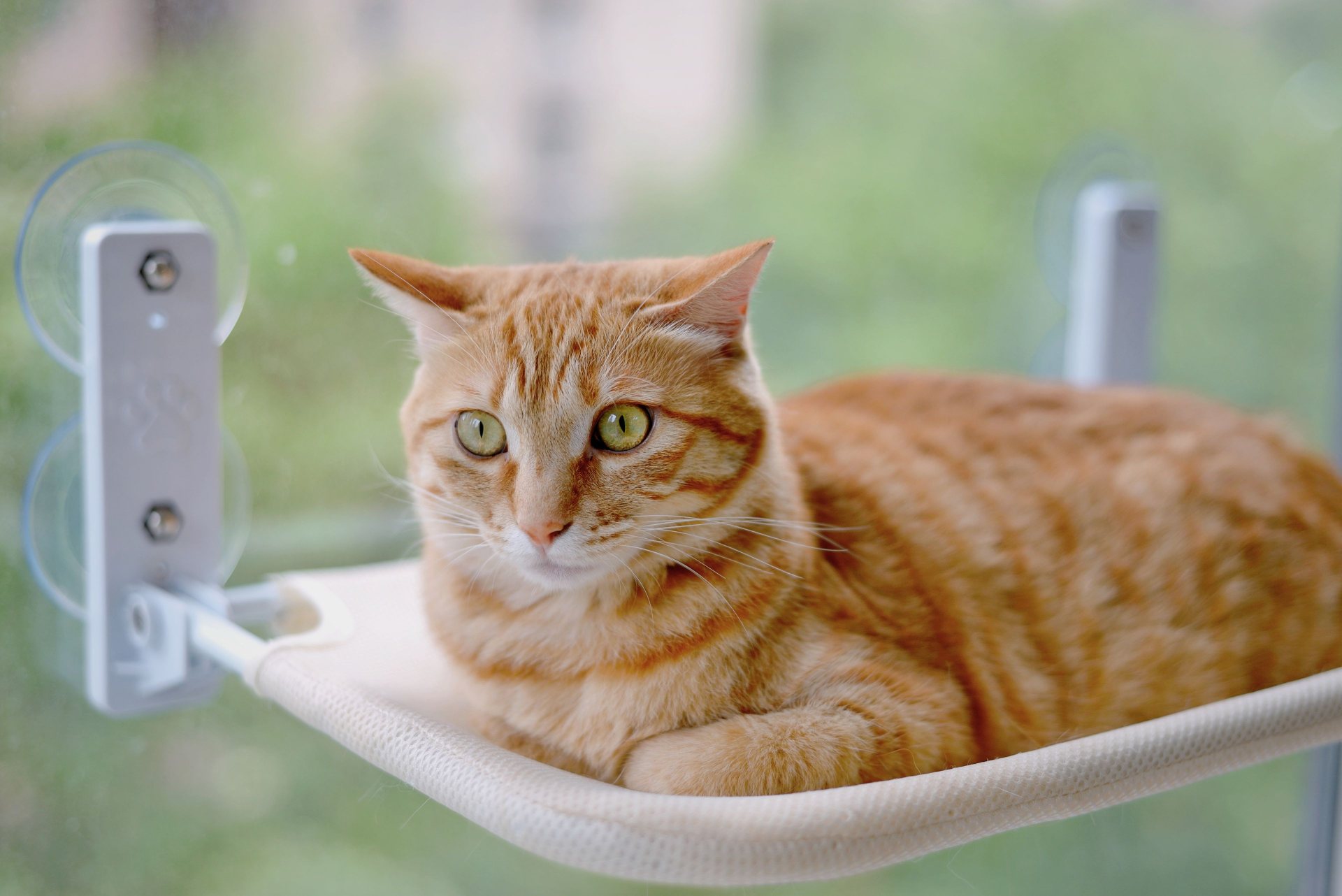
A cat window perch is one of the highest-value pieces of cat furniture you can add. It gives a cat height, a view and a warm spot without using floor space. For an apartment cat, the window is often the best television in the house: birds, leaves, neighbours, weather and the changing light. A perch turns that view into a destination.
Placement matters more than the shape of the perch. Choose a window where the cat already likes to sit, ideally with a few hours of sun but not a spot that becomes dangerously hot in summer. Avoid a window right beside a noisy lift shaft or a door that slams. Check that the cat can reach the perch with a comfortable jump and that there is a safe route down. A perch that is too high or too isolated may be ignored.
If you have more than one cat, add more than one high spot. A single window perch can become a resource to guard. Two perches in different rooms, or a perch plus a wall shelf, give a shyer cat somewhere to go without a confrontation.
Cat window perch suction cups: safety and setup
Most window hammocks attach with suction cups, and the cups are the part that decides whether the perch is safe. Clean the glass and the cups with mild soap and water, dry both completely, then press each cup firmly. Suction needs a smooth, non-porous surface; textured glass, heavy dirt, tinted film or a window with a deep frame may not hold. Follow the manufacturer's weight limit and check the perch before every use at first.
Re-seat the cups weekly and replace any that have gone hard, cracked or lost their shape. Heat and sunlight can soften rubber over time, so a perch that held all winter may need attention in summer. Do not let a cat launch onto the perch from a high shelf or a running start; that adds force the cups were not designed for. If you are unsure, place the perch low at first and watch how your cat uses it.
Window perches for large cats
A large cat needs a wide, firm platform, not a sagging sling. Check the interior dimensions and the stated weight rating, and measure your cat across the shoulders rather than guessing. A hammock that is fine for a seven-pound cat may dip uncomfortably under a fifteen-pound cat. If your cat is heavy or jumps hard, a wall-mounted shelf fixed into studs is the sturdier choice. Do not rely on suction alone for a cat that is over the manufacturer's limit.
Cat wall shelves: building a route, not a ladder
Cat wall shelves turn a blank wall into territory. The goal is a route with landings, not a vertical ladder that a cat has to climb nose to tail. Space the shelves so your cat can step or make a comfortable jump between them, and make each landing wide enough to sit or lie down. A shelf that is only just wider than the cat is a balancing beam, not a resting spot.
Fixings are the whole safety story. Shelves should be anchored into studs or suitable wall anchors, and every fixing should be rated for the load. A cat landing on a shelf creates a dynamic pull, not a static weight. If you rent, ask before drilling and do not improvise with adhesive hooks. A floor-to-ceiling pole or a window perch is a better option when you cannot make secure holes. Our apartment-friendly cat furniture guide covers renter-friendly layouts in more detail.
Give the route a purpose. A shelf near a window becomes a lookout; a shelf above a radiator becomes a warm nap spot; a shelf beside a bookshelf becomes a bridge. Add a soft pad or a small blanket to one landing so the cat has a reason to stay. If your cat ignores the shelves, check the spacing, the height and whether the first step is easy to reach from a familiar surface.
Indoor cat activities that use the brain
Physical exercise is only half the job. Indoor cats also need to solve problems, use their nose and make choices. Food puzzles are an easy way to add that without another piece of furniture. An adjustable treat puzzle ball turns a handful of kibble into a rolling challenge, and the adjustable openings let you start easy and make it harder as your cat learns. Use part of the daily food ration rather than a whole extra meal, and check the toy for cracks or loose parts.
Other low-effort activities include hiding a few treats under cups, scattering kibble in a snuffle mat, putting a cardboard box on the floor and rotating it with another box, or training a simple behaviour such as touching a target. Cats are good at scent games; a piece of bedding from another room can be more interesting than a new toy. The point is novelty and agency, not a perfect training session.
Keep activities short and stop before your cat walks away. A puzzle that is too hard is frustrating; a puzzle that is too easy is boring. Adjust the difficulty and let the cat succeed. If your cat is on a prescription diet or has a medical condition, check with your vet before changing how food is delivered.
Cat enrichment toys: wand play and solo play
A feather wand is still the most reliable way to trigger a cat's hunting sequence. Move it like prey: short pauses, sudden darts, a slow drag along the floor, a hide behind a chair leg. Let the cat catch it now and then, then give a small treat or a meal. A session that ends with a successful catch is more satisfying than one that ends when you get bored.
Five to ten minutes of focused wand play often does more than an hour of a toy lying on the floor. Put the wand away afterwards, especially if it has a string or feathers; a cat can swallow loose pieces or get tangled. Supervise any toy with a cord, and retire toys that are frayed. Solo toys such as balls, mice and crinkle sacks are useful for independent play, but they work better when you rotate them and pair them with food or scent.
You can browse more options in our cat toys category. Resist buying a large assortment at once. Two or three toys that you rotate, plus a wand session and a puzzle feeder, will keep most indoor cats busier than a cupboard full of novelty items.
Scratching and climbing in one place
A floor-to-ceiling cat scratching pole solves two problems at once: it gives the cat a full-height stretch and a reason to climb. The tension mount means no wall drilling, which is useful in a rental, but it needs a solid ceiling and careful adjustment. Check the manufacturer's weight limit, tighten the pole as directed and test it before your cat launches at it.
Place the pole where the cat already scratches or climbs, not in a spare room. A corner beside the sofa is often better than a tidy spot behind a door. If the pole wobbles, the cat will avoid it; re-tighten the tension and check that the ceiling surface is suitable. Add a perch at the top if the model supports one, and make sure there is a safe route down for a cat that is not confident.
Scratching and climbing are not naughty behaviour. They are maintenance, exercise and territory marking. Providing a good outlet is kinder than punishing the cat for using the sofa. If scratching is already a problem, our furniture scratching guide explains how to redirect it. You can also browse cat trees and scratchers for different heights and surfaces.
A simple weekly enrichment plan
- Every day: one short wand or toy session, and part of the daily food in a puzzle or scatter feed.
- Every day: a few minutes at the window, with the perch moved slightly if your cat has lost interest.
- Two or three times a week: hide a few treats or swap a cardboard box for a new one.
- Once a week: check the suction cups, shelf fixings and scratching pole tension.
- Once a week: rotate the toys and wash any soft perches or blankets.
- Once a month: change one thing — a perch position, a puzzle difficulty or a new route up the shelves.
This is a menu, not a checklist. A cat that sleeps all afternoon does not need constant entertainment. The aim is enough options that the cat can choose. If your cat ignores everything, check the basics first: perch position, a clean litter box, a warm bed and any changes in the household.
Enrichment in a small apartment
Small homes reward vertical thinking. A window perch, a wall shelf route and a floor-to-ceiling pole use height instead of floor area. Keep the floor clear enough for a running game, and avoid blocking the cat's route between the window, the scratcher and the litter box. A cat that has to squeeze past a buggy and a stack of boxes will use the space less.
Noise and smell matter too. A perch beside a loud television or a strong air freshener may be less appealing than a quiet window in a bedroom. If you live in a rental, choose removable or tension-mounted options where possible and check every fixing. Our apartment-friendly cat furniture guide has more on footprint, mounting and shared rooms.
Long-haired cats and enrichment
Long-haired cats benefit from the same climbing, scratching and play routine as any other cat, with a little extra grooming built in. A perch with a washable cover, a scratching pole and a soft brush near your favourite chair make it easier to keep the coat in check. Brushing is not enrichment for the cat, but it is a calm, hands-on routine that can become part of the daily pattern.
If your cat has a dense coat, watch for mats behind the ears, under the front legs and around the back end. A cat that stops grooming may be sore or unwell, not just lazy. Our long-haired cat grooming guide covers tools, mat handling and when to ask for professional help. Keep grooming sessions short and pair them with a treat or a play session so the cat does not learn to run when the brush appears.
Our shortlist
Our shortlist covers the pieces we would add first: a window perch for a view, a wall shelf set for vertical territory, a puzzle ball and a wand for hunting and problem-solving, and a floor-to-ceiling pole for scratching and climbing. We look for stable fixings, washable surfaces and toys that are simple to use. We do not claim that any of these will suit every cat, and we do not invent test results. Check the dimensions, weight limits and mounting requirements on the live Amazon listing before you buy.


When a bored cat is not just bored
Not every change in behaviour is an enrichment problem. Contact your vet if your cat suddenly stops eating, overgrooms to the point of bald patches, hides for long periods, avoids the litter box, becomes aggressive or seems restless and vocal at night. Pain, dental disease, thyroid problems and other medical issues can look like boredom or stress. A cat that is genuinely under-stimulated often still eats, sleeps and uses the litter box normally; a cat that is unwell often does not.
If your cat is healthy but still seems flat, review the basics: play sessions, window access, scratching outlets, hiding places and social contact. A single change, such as moving a perch or adding a puzzle feeder, can be enough. If the behaviour continues, a veterinary behaviourist can help you build a plan that fits your home.
Enrichment is not a race to buy the most furniture. It is a way of making an indoor life more interesting for a cat that depends on you for almost everything. Start with one window, one scratcher and five minutes of play. Build from there, and let your cat tell you what works.
Related guides
- Kitten starter kit checklist for setting up a new kitten's first room and routine.
- Apartment-friendly cat furniture for small-space layouts and renter-friendly mounting.
- Long-haired cat grooming guide for keeping a dense coat comfortable alongside all that climbing.
Common questions
Do window perches work for large cats?
Some do, but check the manufacturer weight rating and the size of the suction cups before buying. A large cat needs a wide, firm perch and a mounting surface that can take the load. If your cat is heavy or boisterous, a wall-mounted shelf fixed into studs is usually the safer choice than a suction-mounted hammock.
How do I stop window perch suction cups from falling off?
Clean the glass and the suction cups with mild soap and water, dry both completely, then press each cup firmly into place. Suction cups need a smooth, non-porous surface, so they may not hold on textured glass, tinted film or a dirty window. Check them weekly, re-seat them if they lift, and replace cups that have gone hard or cracked.
Are wall-mounted cat shelves renter friendly?
They can be, but only if you can make secure fixings. Shelves need to be anchored into studs or suitable wall anchors, and a heavy cat puts real load on them. Ask your landlord before drilling, and consider a freestanding floor-to-ceiling pole or a window perch if you cannot make holes. A shelf that pulls out of the wall is dangerous for the cat and the deposit.
How much playtime does an indoor cat need?
There is no exact number that suits every cat. Two or three short sessions of five to ten minutes are often more useful than one long session, especially for a cat that loses interest quickly. End while your cat is still engaged, and follow their energy rather than a timer. Kittens and young cats usually want more; seniors may prefer gentler, shorter play.
What are easy indoor cat activities?
Hide a few treats around the room, put kibble in a puzzle ball, leave a cardboard box out, move a perch to a new window or spend five minutes with a wand toy. Rotating toys and changing the view are often more stimulating than buying more things. Simple scent games and clicker training also count as enrichment.
How do I stop my cat getting bored with the same toys?
Rotate them. Keep a few toys in a cupboard and swap them every week or two, so they feel new again. Pair a toy with food or play rather than leaving it on the floor, and retire anything that is broken or has a loose string. A window perch, a scratching pole and a puzzle feeder give your cat more to do than a basket of toys alone.
Browse the full shortlist
Independent picks, live prices on Amazon, no account needed here.